Woodworking tips · Tip 14 of 20
Plan your plywood cuts so you buy fewer sheets
Most plywood comes in 4 × 8 ft sheets, and a few inches on a plan can be the difference between buying one sheet and two. You can plan the cuts on paper before you buy anything. The drawings below come from our free plywood cut calculator, and each one links to the same plan so you can change a number and see what happens. The calculator uses a rule of thumb: another layout might use less plywood, so treat its drawing as a starting point.
The blade's width adds up
Every cut turns some wood into sawdust. This is called the kerf, and it's often about 1/8 inch on a circular saw, so check your blade. One cut barely matters, but five cuts take 5/8 inch (5 × 1/8). A sheet is 48 inches wide, so six strips of 8 inches would fill it exactly, with nothing left for the saw. When we told the calculator the blade was zero wide, it said one sheet. With a blade of 1/8 inch, it said two sheets. If your plan is that tight, make one piece a little narrower or count the cuts.
Make the long cuts first
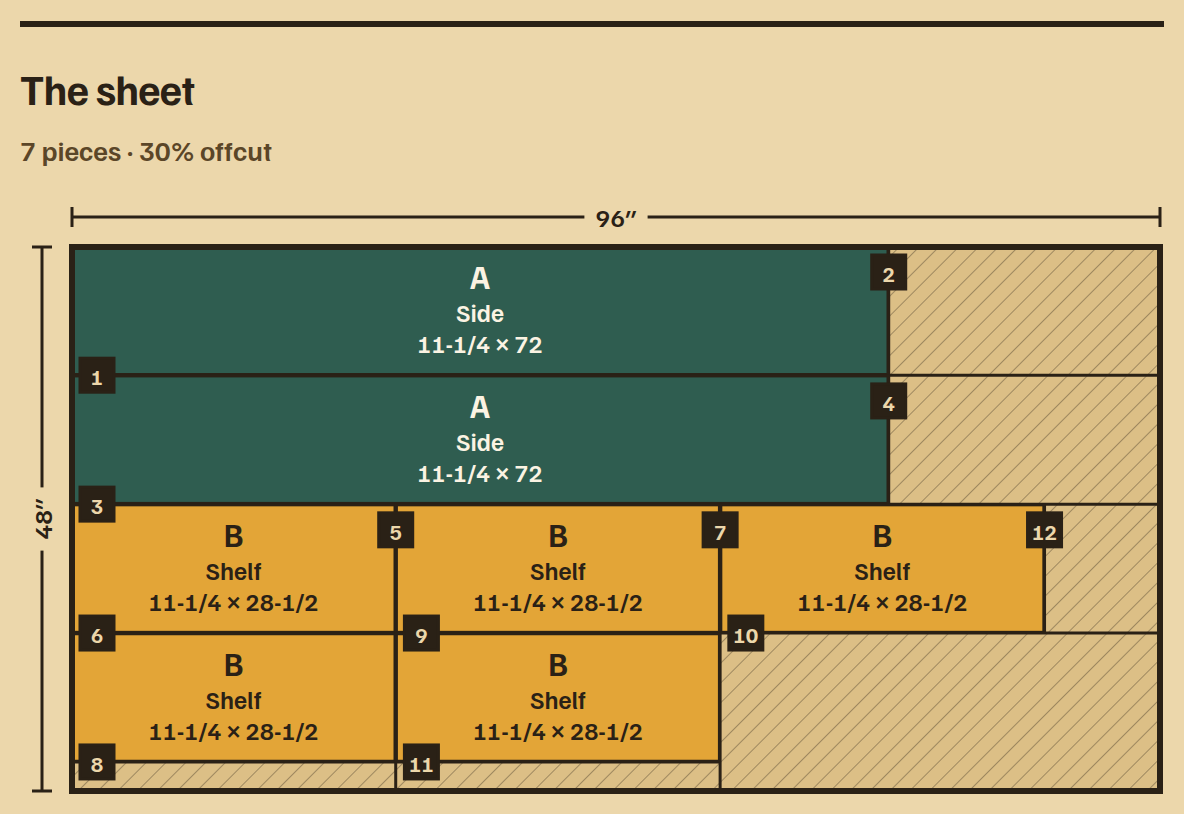
A cut that runs the full length of the sheet breaks it into strips that are easier to handle than a whole sheet. The strips then get shorter cuts across them. The calculator's numbered plan works the same way, as in the drawing below. It plans a bookcase with two sides, 11-1/4 × 72 inches, and five shelves, 11-1/4 × 28-1/2 inches: seven pieces on one sheet, 30% offcut and 12 cuts. Cuts 1 and 3 run the full length of the sheet. Every cut after that is shorter.
Open this plan in the calculator
Group parts that are the same width
In that bookcase the sides and the shelves are all 11-1/4 inches wide, so they come from the same strips and one long cut serves several parts. If your plan has parts of many different widths, see whether you can make a few of them the same width. A shelf that's an inch deeper can mean an extra long cut and a strip you can't use.
Keep a big offcut whole
Look at the hatched areas in the drawing. The large piece in the lower right is one whole offcut, big enough to use on a small project later. Small leftovers scattered around the sheet are much harder to use. When you plan by hand, put the parts toward one end and leave one big piece, not many strips.
Check when grain direction matters
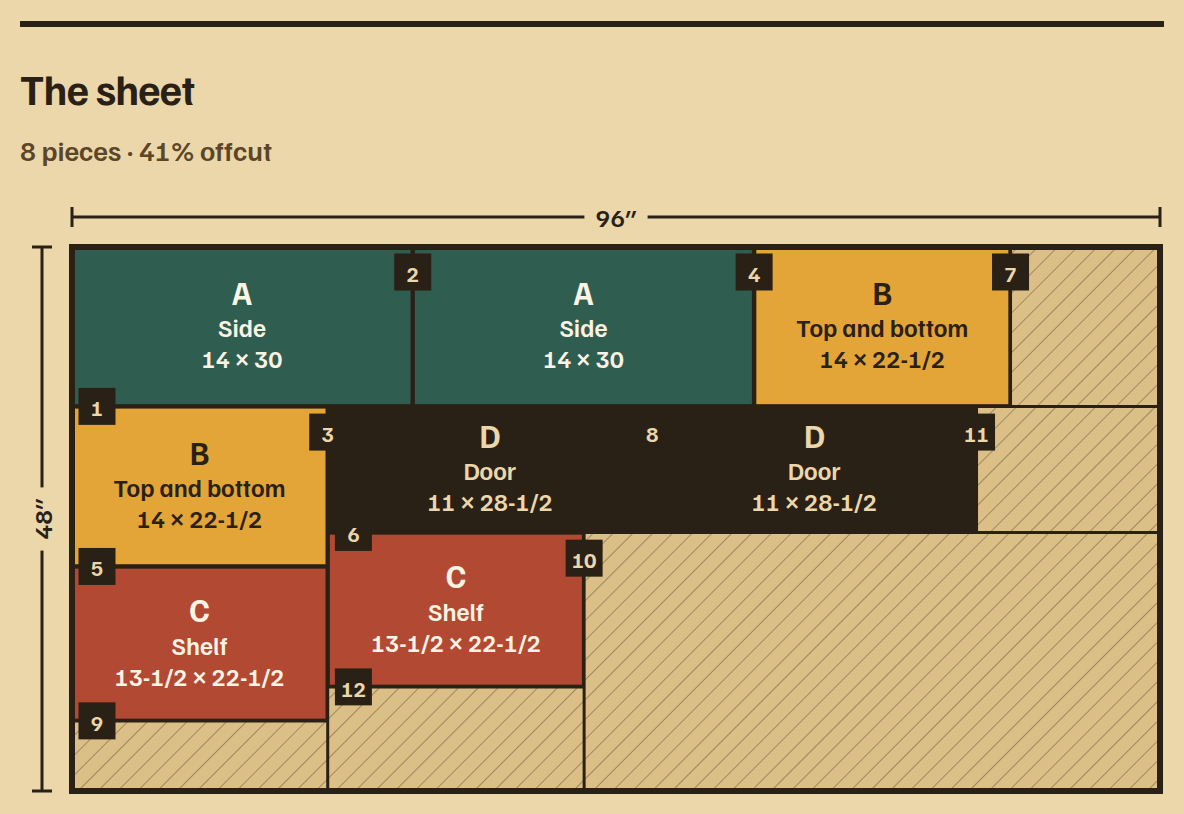
On most sheets the face grain runs along the 8 ft length. A part's width is across the grain and its length is along it. If the grain won't show, such as on a shop cabinet, parts can be turned sideways to fit, and the calculator does that on its own. If the grain will show, tick "Grain must run lengthwise" so every part keeps the grain along its length. It can take more plywood. For a small cabinet, with turning allowed the calculator showed one sheet, 41% offcut and 15 cuts. With the grain kept lengthwise, in the drawing below, it showed one sheet, 41% offcut and 12 cuts.
Open this plan in the calculator
Here the lock cost no extra plywood, but sometimes it does. Six panels of 30 × 20 inches fit on one sheet (22% offcut) when they can be turned, and need two sheets (61% offcut) when the grain has to run along the 20-inch side.
Buy a spare for a big project
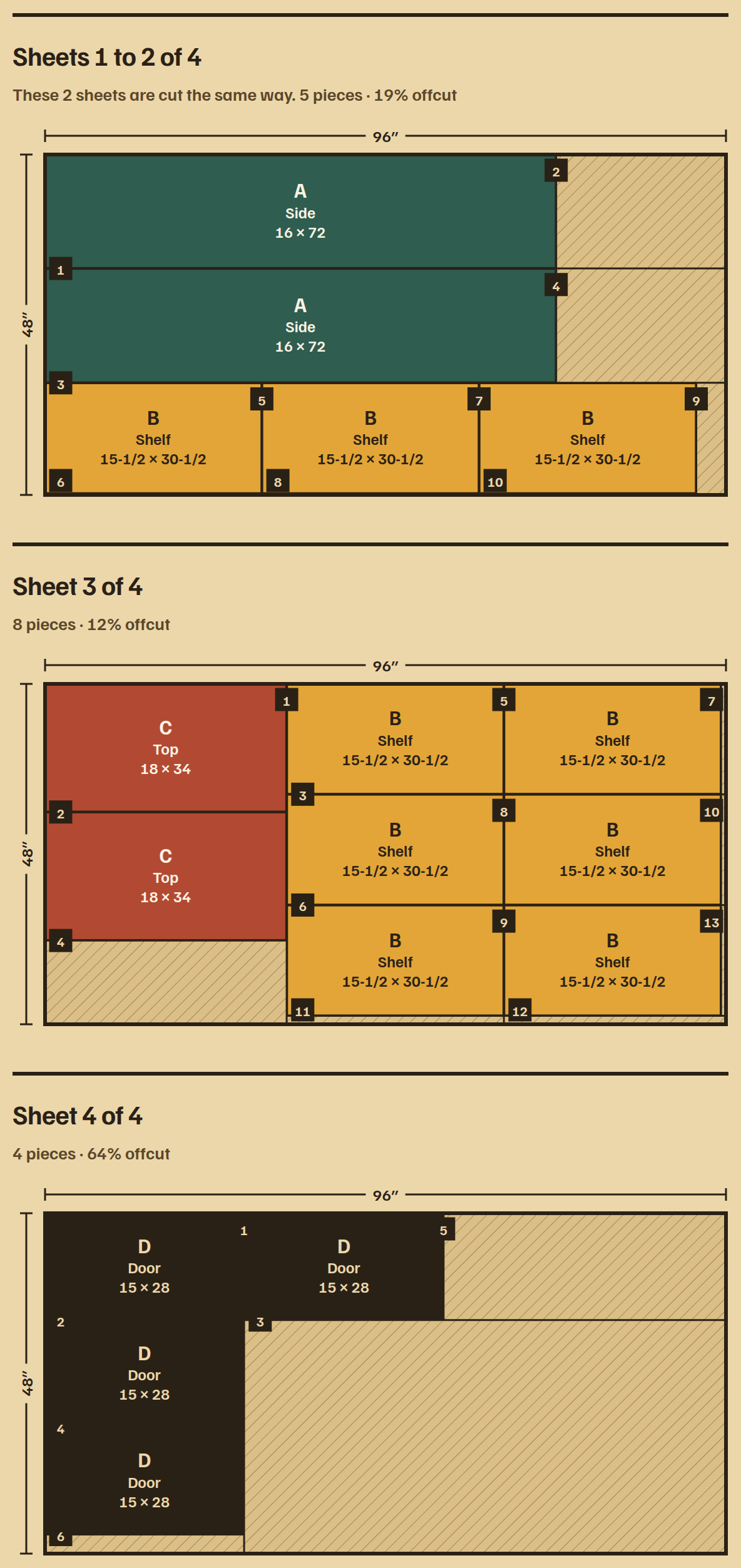
One bad cut, a void in the plies or a dented corner can cost you a piece. For a project that needs several sheets, one extra sheet covers the mistakes, and the calculator suggests it when a plan needs three or more. This larger plan has 22 pieces: four 16 × 72 sides, twelve 15-1/2 × 30-1/2 shelves, two 18 × 34 tops and four 15 × 28 doors. The calculator said four sheets, 28% offcut and 39 cuts, and suggested buying one spare. The first two sheets are cut the same way, and the last sheet is mostly offcut. Check that before you decide how many to buy.
Open this plan in the calculator
Check your own sheet
Measure the sheet you buy, because sizes vary a little between mills and stores. The example sizes here are ours, so use your own parts. Once the plan is set, our tip on cutting a full sheet covers the saw work. For the list itself, see how to read a cut list, and for more habits like these, get our free starter guide.